
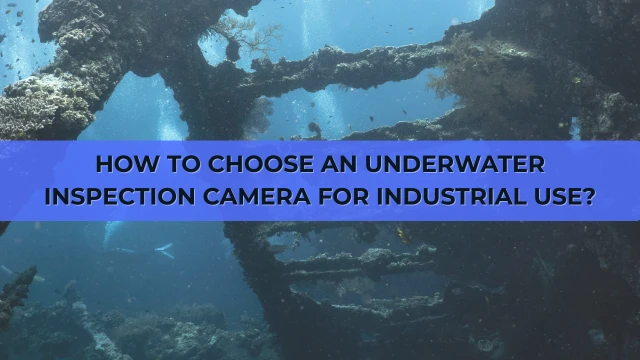
There are several industrial applications where underwater inspection cameras can be employed. Different places would need different types of cameras to get the best results in terms of footage and work done. Whether you want to check a water blockage or erosion inside massive water structures, underwater inspection cameras are great to reduce risk to humans. These cameras also help us make inspections from a distance while saving on money and human effort.
But choosing the right inspection camera is not easy because most of us either buy them for the first time or don’t actually know what features to look for. The industry sells specifications, but the majority of inspections fail because of the environment mismatch. For example, a 4K underwater inspection camera is useless in water with visibility of up to 1 or half a meter. However, a budget camera would work perfectly in a clear borehole. The hidden truth is that most industrial inspections happen in low visibility rather than open waters.
These cameras are not cheap, so you don’t want to waste your money on a product that doesn’t work. So, this article is more about avoiding the wrong camera while making sure you understand your needs first, and then picking the right camera for the task at hand. Let’s first discuss a little of the possible applications where underwater inspection cameras are generally used.
Understanding Industrial Use
Industrial underwater environments are generally unpredictable, dirty, and often inaccessible for humans. Dedicated cameras are required to go inside and check for various things, such as corrosion or cracks in the structures, the environment in the base, or aquaculture. They can be used to check boreholes and dams. Consumer cameras are designed for moments, while industrial cameras are designed to operate continuously for hours. Industrial conditions are generally harsher. The cameras are prone to chemical exposure, slit accumulation, and biofouling (the growth of organisms on the lens over time).
The usage might include dams, offshore rigs, hull inspections, propeller checks, port infrastructures, and industrial tanks. There can be hundreds and even thousands of applications, and each type will require a camera with the right specifications. This is what we are going to discuss in this article.
The type of camera will vary depending on your purpose. For example, if you want continuous monitoring at a single place, a good underwater CCTV will be good. In other cases, where the area of inspection is narrower, a drop camera will be more suitable. ROVs (Remotely Operated Vehicles) can be used where we need to go really deep and where the divers can’t go due to depth or safety reasons. The industrial cameras are built for different purposes compared to the consumer camera. You will see these cameras designed with these elements in mind.
- Pressure resistance (deep wells, subsea)
- Long cable transmission without signal loss
- Corrosion resistance (saltwater)
- Serviceability (modular repairs, not replacements)
Types of Underwater Inspection Cameras
There is no single type of camera for underwater inspections. Based on their applications, specifications, and pricing, you can pick from a variety of cameras. Below are the most popular ones.
1.Drop Cameras
These are the most basic types of underwater inspection cameras. They work on gravity-assisted deployment. These are ideal for vertical shafts and for the inspection of the base underwater. For example, if you want to inspect the corrosion around an open bar, these cameras can be good enough to save your money and operational efforts. They are great for borewell inspections, shafts, and narrow tanks where the inspection path is vertical. However, the biggest limitation of these cameras is that they provide no lateral inspection. But, there are some drop cameras that come with 360° rotation. So, it is worth checking before buying.
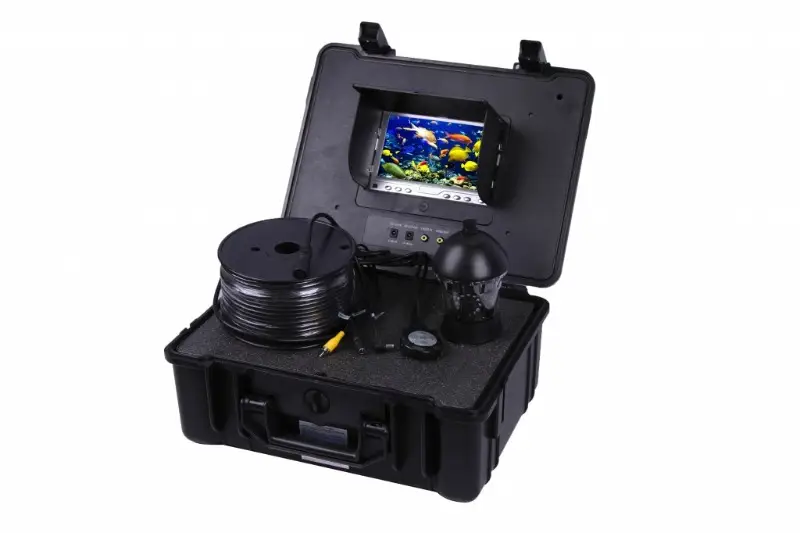
2.ROV Systems (Remotely Operated Vehicles)
ROV systems have their own propulsion and control. They are generally operated by humans and can go to far places where humans cannot go. These cameras dominate in dam monitoring, ocean observation, reservoir monitoring, and most other underwater applications. The thrusters in them enable basic motion and functions such as hold position, strafe, and yaw. The biggest constraints of these cameras are tether drag, signal latency, and required pilot skills. However, if you have a limited area to cover with a good person handling this camera, it can be a great pick for any scenario requiring navigation, sidewall inspection, or coverage of large and complex assets.
The size of ROV cameras can vary, and they can be much more expensive than ordinary drop-off cameras.
3.Fixed Underwater Camera Systems
These are more general types of underwater cameras. You can imagine them as the underwater CCTVs. They are typically used in ports and harbors for security and infrastructure monitoring. They can also be utilized for aquaculture and debris monitoring in intake structures. They are made for long-term optical clarity and do not generally focus on higher resolution. They are resistant to vibrations and micro-movements because of stable mounting.
Because these cameras are always underwater, special considerations for anti-fouling, power usage, and field of view planning become important. It is important to clean them regularly so that the view doesn’t get obstructed.
4.PTZ (Pan-Tilt-Zoom) Underwater Systems
These can be considered as the upgraded or advanced version of the drop-off cameras. As the name suggests, we can do controlled framing without deploying an ROV. We can zoom for more details if the visibility allows. However, because the pan and tilt assembly requires sealing and a pressure rating, it becomes important to keep the body secured.
These cameras are great for medium-scale structures or other places where maneuvering isn’t necessary. They can be well-suited for inspections from a fixed mounting point (e.g., tank walls and intake zones)
Factors to Consider for Buying an Underwater Inspection Camera for Industrial Use
Below are the most important field-focused buying factors. Each parameter will help you reach the final decision.
1.Depth Rating (System-Level, Not Just the Camera Head)
The whole camera assembly must be depth rated rather than the camera head only. It includes camera housing, connectors, cable jacket, internal insulation, and strain relief points. For example, a micro-leak at the connector will result in condensation and then corrosion, which can easily result in total failure later on. It is better to apply a 1.5x safety margin over the max operating depth. For a maximum working depth of 50 meters, it is good to have a camera rated for 75 to 100 meters. Make sure you check for pressure test certification and not just the claims.
| Connector Type | Suitable Depth | Reliability | Cost | Use Case |
| Basic Waterproof (IP68) | <30–50 m | Low | Low | Light-duty or temporary use |
| Industrial Sealed Connectors | 50–150 m | Medium | Medium | General industrial underwater inspection |
| Subsea / Wet-Mateable Connectors | 150 m+ | High | High | Offshore, critical operations |
The maximum depth you want to go depends totally on where you want to employ the camera. The main point here is that it is better to get a camera whose depth rating seems an overkill. Never ignore the depth rating or try to use the camera deeper than its rating. A higher water pressure than what is rated will seep inside the body and will destroy the camera and its internal components.
2.Image Quality
Image quality is the next factor deciding which underwater inspection camera you should go for. Although the underwater footage is impacted majorly by the clarity of the water, light, and particles, it is important to go for a camera with acceptable footage quality. A larger sensor size combined with a good dynamic range will help you achieve better quality video compared to a smaller sensor size with higher resolution numbers.
Resolution is overrated in most cases because in turbid water, the visibility can be lower than 1 meter, and a higher resolution would not have any impact on the video quality. So, you should prioritize good noise handling and contrast, not just the megapixels. Larger sensor size captures more light per pixel, which basically means a better image quality compared to a smaller sensor. Consider this table before you make your decision.
| Sensor Size | Typical Use Case | Low-Light Performance | Noise Levels | Real Underwater Clarity |
| 1/3″ or smaller | Budget cameras | Poor | High | Grainy, unusable in murky water |
| 1/2.8″ | Entry industrial | Moderate | Medium | Acceptable in clear water |
| 1/1.8″ | Professional systems | Good | Low | Clearer images in low visibility |
| 1″ or larger | High-end systems | Excellent | Very Low | Best possible clarity in harsh conditions |
The underwater cameras start from 720p and go up to 4K resolution. The price will also vary depending on these specifications. So, if you want the best performance in terms of backscatter with lower noise, a higher resolution is good. But when you know you are going to work mainly in murky water, even a lower-resolution camera will provide you with similar results.
3.Lighting
Most industrial camera buyers underestimate the lighting part while focusing more on the resolution. But, lighting actually decides whether the camera sees anything at all or how well it sees under clear or murky water. The most important lighting factor is the beam geometry. A narrow beam (between 10 and 30 degrees) is great for longer reach and for a better focused inspection, such as cracks and joints. However, a wider beam of more than 60 degrees will cover more, but have lower intensity per unit area.
Backscatter is another important concept. It is the amount of suspended particles reflecting light back into the lens. It appears as snow or haze and can impact the overall quality of the video. If the water has a lot of particles and is reflecting a lof of light, more light would be of no use. In this case, the offset lighting or dimming controls would be important. So, make sure your industrial underwater inspection camera has all these additional lighting features.
4.Mobility
As we discussed earlier, the simple drop-off cameras hardly have any mobility because they just hang on their wire. However, if you want to pan or zoom inside water, it is good to opt for 360-degree movement cameras. ROVs can also be great if you can afford them. ROVs also have different configurations, like 2, 4, or 6 thrusters. More thrusters simply mean more movement, while a simple 2-thruster ROV can move forward and backward with limited turning capabilities.
5.Cable
The cable of your camera defines its signal quality, range, and mobility. It is easy to ignore the quality, type, and weight of the cable, but it impacts the majority of the camera applications. A good cable must have a buoyancy design, abrasion resistance, and proper strain relief and connection points.
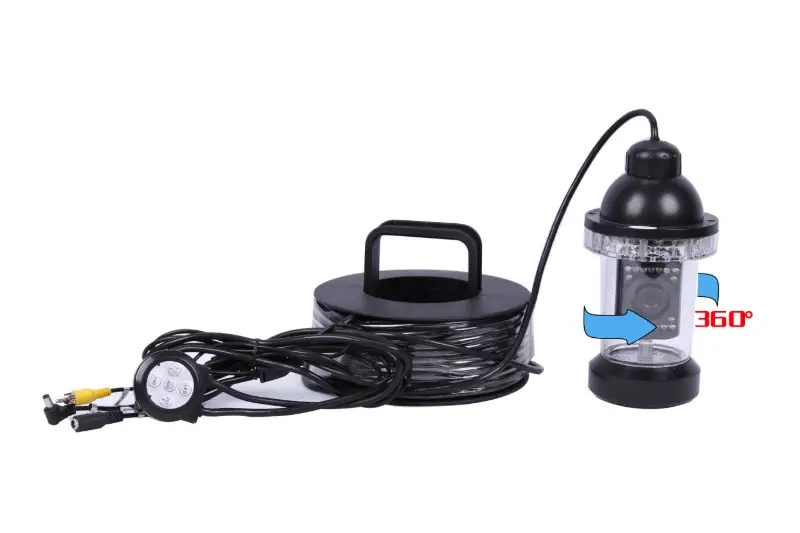
Fiber optics cable has higher bandwidth and lower signal loss. They are ideal for long-distance and high-quality videos. But they are more fragile and increase the price of the camera.
Copper cables are more common, cheaper, and robust. However, the signal degrades over longer distances, and they have limited bandwidth for high-resolution feeds. So, if you are going for a low-resolution camera for low-distance operations, a copper cable will be good enough. But in high-end cameras, you generally get a fiber cable by default.
6.Power System
You will get two main types of power systems in underwater inspection cameras, i.e., battery-powered and tethered. Now, in industrial applications, these cameras have to run for longer runs, and you will probably not want to get into the hassles of battery charging. For longer inspections, the tethered systems are great, which give continuous power to the camera from the surface. However, it adds cable complexity and drag inside the water.
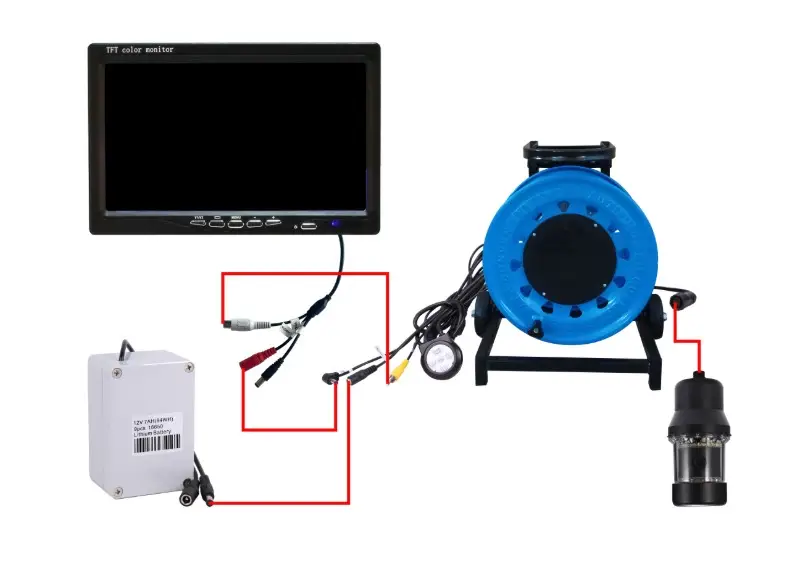
The battery-powered systems have high mobility and no power cable constraints, but they have limited runtime. So, it depends on how long you are going to use your camera and whether you are ok with the additional cable management and the drag that comes along.
7.Durability
The material choice and sealing design of your underwater inspection camera will decide its durability. Generally, these cameras are used in harsh environments so it becomes important to check the durability before you make your decision. You will find three main types of materials used in these cameras.
- Stainless Steel
- Aluminum (Anodized)
- Plastic
Stainless steel bodies are heavy and expensive but highly corrosion-resistant. Aluminum designs are much lighter and cheaper, but vulnerable to internal damage if the coating is damaged. Plastic bodies are corrosion-proof but have lower structural strength.
8.Sensors
An image sensor is one thing. We have the most popular sensor type, which is a CMOS image sensor, while some older models have a CCD sensor. The job of the image sensor is to convert the light into a digital image or video. But industrial inspection cameras are equipped with other sensors to facilitate underwater inspection in different environments. Some of these additional sensors to look for are as follows.
Pressure Sensor: Measure water pressure to estimate depth.
Temperature Sensor: Measures water temperature, helping with thermal pollution and equipment overheating.
Orientation Sensor: Useful in tracking tilt, rotation, and movement of the camera.
Sonar Sensor: Uses sound waves to “see” in low or zero visibility.
These sensors are additional, and most underwater cameras will not have all these. But when you are going to get the best of the best, all these sensors improve the functionality of your camera and offer you advantages over the normal ones.
Matching the camera to the job
As we discussed earlier, picking the right underwater inspection camera for any industrial purpose is more about knowing your requirements rather than just choosing the right specification. Let’s map what you can expect from which camera and where it will be most suitable.
| Use Case | What to Prioritize |
| Borewell inspection | Depth + cable length + lighting |
| Offshore inspection | ROV + sonar + PTZ camera |
| Dirty/muddy water | Sonar > resolution |
| Structural inspection | Laser measurement + zoom |
How is search and monitoring done with industrial underwater inspection cameras?
The process of using underwater cameras in different industrial applications will vary a lot on the given environment. But some phases can be used in almost all types of inspections.
1.Deployment and Search Phase
In industrial underwater inspections, you generally know your goal and the area you want to deploy your camera. These are not random explorations but guided deployments in open water, dams, and offshore structures. Based on the area, your budget, and expertise, you can use cable reels, robotic crawlers, or ROVs. You may want to use external lighting if the visibility is near zero. Most underwater cameras have LED arrays around the lens so you can utilize them.
Depending on your camera, you can operate it as you want. This will include rotating the camera head or zooming into suspected defects. High-definition cameras might be required to inspect joints, welds, cracks, and blockages.
2.Controlling and Maneuvering
An expert or a person with sufficient knowledge will be required to operate the underwater camera. Different cameras will have different controls, so learning them is important to get the best results.
3.Real-Time Monitoring
The camera operator will watch through the live feed in the DVR and operate the camera through the given controller. Now, the on-screen data will vary based on the sensors in the system. Even in the cheapest cameras, you get a live video feed, but in advanced cameras, you will also get other things like depth, temperature, cable length, orientation, and lighting controls. You can also record or timestamp the video feed if you want. However, some cameras might be utilized to check underwater structures, and in that case, a recording might not be required.
4.Data Capture and Logging
If the data is required for offline monitoring or record-keeping, the operator might capture it and store it in a long-term storage medium. Operators can add annotations and use other DVR features for recording and playback. Some systems will integrate depth ratings, distance, and temperature inside the video recording.
5.Continuous Monitoring
One of the major differences between industrial and regular underwater monitoring is that regular monitoring. In some cases, you may have to install cameras permanently in some places. But, for cameras, they are required to have constant power or longer battery lives in case they are portable in nature.
Conclusion
Choosing a good underwater inspection camera for any industrial use is fairly easy. Make sure to choose a camera with a depth rating that exceeds real working conditions, lighting that adapts to low-visibility environments, and a cable system that won’t degrade halfway through an inspection. The type of camera and other specifications will vary depending on your application and the area where you are deploying this camera. In the end, the right camera is the one that works well for your specific needs, rather than having a long specification sheet.