
What an underwater fishing camera shows you depends less on the lens than on how the camera uses light. Infrared light, white LED light, and dual-light designs all solve different visibility problems. For fishing brands, distributors, and OEM buyers, the lighting choice also affects product positioning, cost, user experience, and after-sales risk.
This guide compares infrared vs white light in underwater fishing cameras from both a real-use and product-selection perspective. It will help anglers understand what they see on screen, and it will help buyers decide whether an IR, white LED, or dual-light model is the better fit for their market.
Quick Comparison: IR vs White LED vs Dual Light
As a simple rule, infrared light is useful when natural light is weak and you want a quieter black-and-white image. White LED light is better when the water is clear enough for color detail. Dual-light systems are often the safest choice for brands and distributors because one model can cover more fishing conditions.
| Lighting type | Image result | Best conditions | Buyer notes |
| Infrared light | Black-and-white image with stronger contrast in low light. | Ice fishing, night fishing, deeper water, and cautious fish behavior. | Good for practical visibility, but not ideal when users expect color footage. |
| White LED light | Color image with more natural detail. | Clear water, shallow to mid-depth fishing, product demonstration, and content capture. | Easy for end users to understand, but brightness control matters in murky water. |
| Dual light | Switchable lighting for different water conditions. | Retail models sold across different regions and fishing habits. | Usually a stronger option for OEM and private label product lines. |
| Adjustable brightness | More control over reflection, backscatter, and fish reaction. | Mixed water clarity and changing daytime/nighttime use. | Helps reduce returns caused by unrealistic visibility expectations. |
If you are still choosing the full camera system, read our underwater fishing camera buyer guide first, then use this lighting comparison to narrow down the right configuration.
Infrared light is invisible, which is less likely to spook fish, while white light can attract or scare fish because it is visible in the water. IR is best for use at night and in deep or murky water. White light, on the other hand, is best for day use and in clear water. There are several other pros and cons of both light types, along with applications in different circumstances. In this article, let’s clear up all the confusion so that you can make your decision wisely.
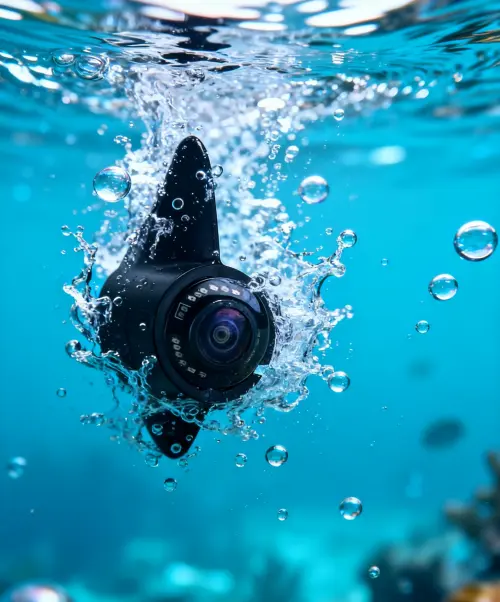
How does light behave underwater?
If we talk about thetechnical aspect of the fishing cameras, they basically capture the light underwater and then send it to the display or DVR through their transmission medium. We have discussed the process in detail in this article about the DVR in fishing cameras. Now, the visible light is scattered and absorbed in the water differently based on its clarity, depth, and other things. For example, more particles in the water will scatter the light more and reduce the clarity of video captures by the camera. However, infrared light (which is invisible) behaves differently because it does not rely on visible color, and hence, we don’t have to worry about the reflections or quality of water.
While light and backscatter
White light contains all the visible colors of the light spectrum. Those colors are prone to bouncing more underwater off everything. So, in the water that has algae, slit, or even the tiny air bubbles, the light reflects straight back after hitting those particles. This results in the camera seeing thousands of small reflections, which then results in haze or floating white dots in the video. This is called snow or backscatter and basically indicates reduced clarity and makes fish harder to distinguish. The more these particles are in the water, the stronger the reflection and the worse the video quality will be.
Infrared light and contrast
We already know that infrared light is outside the visible color spectrum. This light doesn’t illuminate colors and surface details. Rather, it emphasizes how objects block, reflect, or absorb the light based on their physical shape and position. So, when we emit the IR light underwater, many prominent particles like algae, silt, or tiny debris do not reflect it as strongly or brightly as the visible white light. Because of this, fewer particles appear as glowing points on the camera, and it reduces to a snow effect that we discussed is very visible in the white light cameras.
Technically, Infrared illumitation creates gradual differences in brightness rather than lighting everything evenly. Eventually, objects closer to the camera will reflect more infrared light and appear lighter, while objects that are far away reflect less and appear darker. Solid objects such as fish or vegetation interrupt the IR light, which creates shadows and outlines. The images in the IR cameras are built from contrast rather than color, and fish are visible as moving shapes against a darker background. This works well in the murky water, but you compromise color and fine details to get separation between subjects and background.

Understanding White-Light Underwater Cameras
How do white-light fishing cameras work?
Consider this as your smartphone’s flash when you are clicking a picture in a dark area. The flashlight throws the light on the object or area, and the reflected light is captured by the camera. Now, imagine this happening underwater. The camera sensor will produce full-color images and videos in this case. White light gives you natural color reproduction and better detail in clear water. This makes it easier to identify species, vegetation, and lure behaviour more accurately.
Basically, white light is great to get more details if the underwater environment allows you to capture it without the backscatter. Now, it is up to you if you are utilizing it in the right circumstances. The colors will be natural, and it will be easier for you to identify everything underwater without much guesswork. Observing fish and their behaviour will be much more effective compared to the IR cameras.
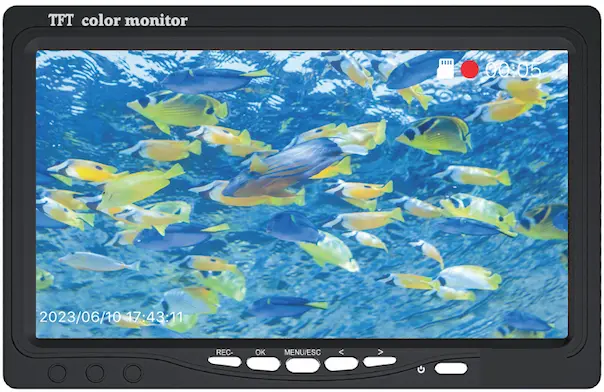
Pros and Cons of White Light Underwater Fishing Cameras
| Pros | Cons |
| Full-color imaging allows accurate identification of fish species, vegetation, and bottom composition | Bright visible light can spook or alter the behavior of fish, especially in shallow or pressured water |
| High image clarity in clear water and daylight conditions | Increased backscatter in stained or dirty water |
| Easier to evaluate lure action and fish reaction | Reduced effectiveness in low-light without strong artificial lighting |
| Longer effective illumination range compared to infrared in clear water | Higher power consumption |
Situations where white light fishing cameras are more suitable
- Murky ot stained water
- Daytime fishing at moderate depths
- Species identification
- Checking lure or bait presentation
- Structure scouting (rocks, weeds, logs, drop-offs)
- Exploring new fishing locations
- Shallow water with vegetation
- Dawn or dusk low-light conditions
- Tracking fast-moving fish
Understanding Infrared Underwater Cameras
How do IR light fishing cameras work?
When you look at the video captured by the IR light camera, it will appear as some bright lights against a darker background. They are grayscale or low-color images. Fishes can’t see the IR light, so it is less disturbing for them. But, in turn, you also do not see any colors. However, what you get is a much better contrast, better shapes, and precise movements. There is less distortion in the video, so if you don’t have to do anything with the colors, IR will give you the best movement capturing and overall structural precision of the objects.
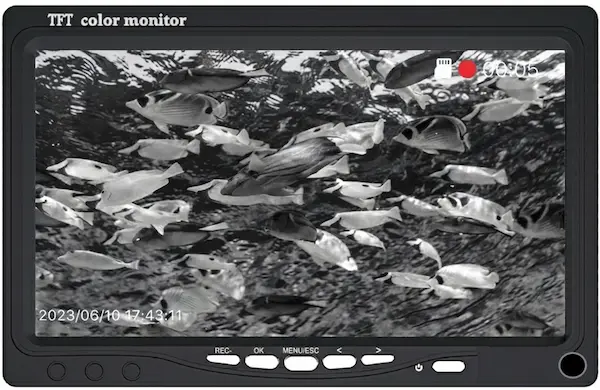
Pros and Cons of IR Light Fishing Cameras
| Pros | Cons |
| Minimal disturbance to fish | Images lack true color, making species identification harder |
| Performs well in low-light, night, or deep-water conditions | Shorter effective illumination range compared to strong white-light cameras |
| Reduced backscatter in murky or particle-heavy water | Lower detail for fine structures like weeds, rocks, or lure action |
| Lower power consumption compared to bright white LEDs | Not ideal for daytime observation, where color and clarity are important |
| Useful for stealthy observation and ice-fishing scenarios |
Situations where IR light fishing cameras are more suitable
- Night fishing or complete darkness
- Ice fishing environments
- Deep water with little or no sunlight
- Observing natural fish behavior without disturbance
- Long-duration underwater monitoring
- Studying feeding patterns and lure reactions
- Stealth scouting before actively fishing
- Places where long battery life is required
Fish Behaviour and Light Sensitivity
When you combine your technical knowledge with biology, you get to know that fish have varying sensitivity to light. Fish under heavy pressure can associate bright light with disturbance. Their eyes are adapted for the underwater environment. The light intensity, color, and its penetration change rapidly depending on the depth and time of day. Some species are highly sensitiveto the light or sudden changes in it, and this can alter their behaviour around a fishing camera.
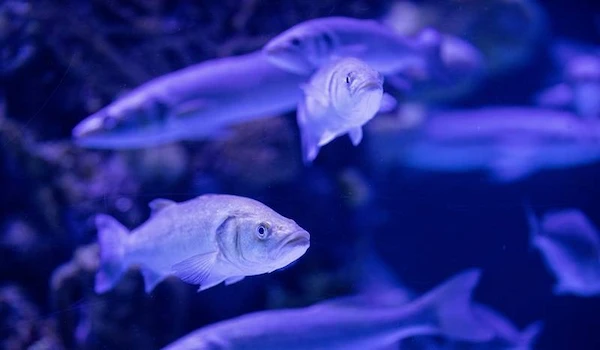
The bright white light will resemble the daylight, which will trigger some responses in fish like attraction, curiosity, or avoidance. Some can be attracted towards the light, while some will just choose to go away from it.
Now, all these reactions to the light can be overcome with the help of IR because it is invisible to both humans and most fish. The biggest benefit of IR is surely the ability to observe in low-light conditions, but overall, you are less likely to miss some fish species that are highly sensitive to the light.
Image Quality and Visibility Comparison
We already talked a little about the pros and cons of both the lights but didn’t compare them directly based on image quality and visibility.
| Feature | IR Light | White Light |
| Video color | Black & white | Full color |
| Detail level | Moderate | High |
| Night performance | Excellent | Limited |
| Daylight use | Limited | Excellent |
| Fish disturbance | Very low | Low to high (species-dependent) |
| Visibility range | Medium | Short to long (depends on clarity) |
| Performance in murky water | Better (less glare/backscatter) | Weaker (more reflection) |
| Effect on fish behavior | Minimal | May attract or scare fish |
| Ideal water depth | Deep water | Shallow to mid-depth |
| Recording realism | High (natural behavior) | Moderate |
When to use a fishing camera with an IR light?
IR Light is most suitable for low-light underwater conditions where visible light performs poorly. As we discussed above, IR light is invisible to most fish. So, it helps us capture images without spooking them. The best use cases for IR light are for night fishing, murky or stained water, deep water fishing, ice fishing, etc. IR light is not ideal in clear and shallow water, especially during the day.
In low-light fishing, IR light can be the best option for catfish, walleye, carp, and night-feeding predators. In ice fishing, IR light will offer you a clear view in the darkness. You can easily confirm fish presence without changing holes.
Lakes deeper than 8-10 meters, where the sunlight fades, the IR light works the best. Again, the fish that are light sensitive, IR is useful.
When to use a fishing camera with white light?
IR has its own advantages, but when used in the right environment, white light can produce the sharpest and most detailed footage. In clear water during low-light conditions, white light will be best. It lets you identify the colors so you can detect species and sizes. For shallow water fishing with the depth less than 5 to 6 meters, white light is generally the most suitable. Basically, if the sunlight is already present, the white light will enhance details without overwhelming the environment.
In the daytime, you can observe how fish approach your bait. Basically, if you want high-quality footage, white light will be the best option for you. But, it isn’t applicable everywhere. So, you have to use it at the right place at the right time.
Dual Lighting Advantage: Why IR and White light make a fishing camera more effective
It is quite evident from this article that each light serves a different purpose and offers advantages in different scenarios. However, a fishing camera equipped with both infrared (IR) and white light provides a wider adaptability that a single-lighting system cannot achieve. The water is unpredictable, and the underwater environment can change rapidly based on depth, clarity, time of day, and fish behavior. With a dual lighting fishing camera, anglers can easily switch between lights, which then allows them to have either more visibility or higher stealth as required.
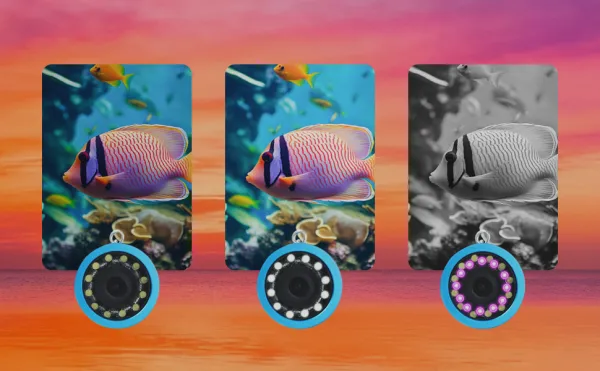
The real advantage comes from combining both systems. For example, anglers can use white light to explore terrain or locate fish and then switch to IR lighting to observe undisturbed behaviour and improve their technique. Dual lighting mode can improve decision-making and efficiency, and ultimately increase your success rates. However, it is important to understand the applications of each light and then switch accordingly. We hope this article has provided you with enough information to get started.
How Lighting Choice Affects Product Positioning and Cost
For a fishing camera brand or distributor, lighting is not only a technical feature. It affects the product promise you make to the customer. A simple white-light model can work well for clear-water markets and entry-level retail kits. An IR model is easier to position for ice fishing, night fishing, and low-light use. A dual-light model usually supports a broader price range because it gives the user more control.
The most common mistake is selling resolution as the main value while ignoring water clarity and lighting control. In real use, bad lighting creates more complaints than a slightly lower resolution. For private label projects, it is often better to define the target market first, then choose the lighting system, screen size, DVR function, cable length, and battery capacity together.
OEM Lighting Options for Fishing Camera Brands
BestWill can support OEM and ODM underwater fishing camera projects with different lighting configurations, monitor sizes, DVR options, cable lengths, packaging, logo, and manual-language requirements. For brand buyers, the goal is not to choose the most expensive lighting system, but to choose a configuration that matches the local fishing environment and retail price point.
If your customers mainly fish under ice or in low light, IR or dual-light models are usually easier to explain. If your market cares more about color images and product presentation, white LED or dual-light models may be better. For mixed markets, dual-light cameras can reduce SKU complexity and make after-sales communication easier.
Recommended BestWill Camera Configurations
For compact retail kits, consider models such as CR110-5HBS. For a stronger mid-range system, the CR110-7HES underwater fishing camera is suitable for many ice fishing and open-water product lines. For larger-screen positioning, the CR110-9L large-screen underwater fishing camera can support a more premium retail offer.
If you are building a private label underwater fishing camera line, send us your target market, water conditions, preferred monitor size, lighting requirement, DVR requirement, cable length, and packaging plan. We can help recommend a practical IR, white LED, or dual-light configuration.
Conclusion
Choosing between white light and IR light ultimately depends on the conditions you are fishing in. From this article, we have tried to reduce guesswork and improve overall fishing efficiency. However, water and the underwater environment can vary pretty widely. So, you will have to experiment with different lights and see what works best at which location.