
Ice Fishing is not only about fishing on frozen water, but it is a mix of survival skills, patience, and technical awareness. The real challenge is that winter compresses fish behaviour and reduces their energy, which forces anglers to adapt to a completely different ecosystem. In extreme cold environments, fish don’t chase but conserve energy due to their reduced metabolism. Another behavioral change is that they become more opportunistic rather than aggressive because of the shortage of food sources. The anglers fail in these situations because of the wrong expectations and impatience.
In the summer, fish behave like active hunters. They compete, chase, and react quickly to everything. However, in winter, their behaviour flips completely. In cold waters, instead of chasing food, they wait for it to come to them. Beginners struggle in ice fishing because they carry over summer habits into winter. They either jig too aggressively or stay in a spot for too long. But the process is actually the opposite. Ice fishing is not about doing more, but about doing less, but more precisely. Even the small mistakes, like making too much noise or using the wrong lure size, can shut down an area completely. Basically, the environment is quieter and clearer, but less forgiving.
In this article, we are going to discuss everything related to Ice Fishing and how to master the skills required for it. You will get to know the challenges, techniques, equipment, and the right strategies to become an expert at ice fishing.
Understanding Ice Fishing Basics
Ice fishing is mainly the process of fishing through drilled holes in frozen lakes. It can either be passive fishing or tip-ups, where a simple device is used to hold your line in the water while you monitor from a distance. The second type is active fishing or jigging, which is a hands-on process and requires constant input. In this, you are actually moving the lure to attract the fish and trigger bites.
Passive Fishing (Tip-Ups)
In passive fishing, the bait is usually suspended at a fixed depth, with no artificial movement. In this strategy, the fish hits out of curiosity. In winter, fish are less willing to chase, so a stationary bait becomes an easy target. So, it becomes a low-effort, low-risk practice for most.
Active Fishing (Jigging)
In active fishing, anglers generally try to attract attention and trigger interest. Basically, we try to force a decision with subtle motion near the strike zone. But there are many mistakes that beginners can make. Too much movement will scare away the fish, and this is what the beginners get wrong. Also, if the rhythm is wrong, we are actually doing an unnatural representation of what is supposed to happen in winter underwater. The best jigging structure is slow, and controller lifts with micro movements that are barely noticeable.
What Makes Ice Fishing Fundamentally Different?
The physics of fishing through ice is different from normal fishing. You get just a tiny hole with limited visibility and movement. However, there aren’t only disadvantages. We have the stillness advantages, unlike open water fishing. Because there is less noise, we have higher chances of success. However, the noises and vibrations can travel faster through ice and water. So, the key takeaway is that you are a quiet angler, and you have higher chances of success.
Beginners over-rely on active fishing mainly because it feels much more productive and effortful. But it is best to combine both active and passive to remove guesswork. So, the main difference between normal fishing and ice fishing is the low visibility and the requirement for higher patience levels. But, to make things easier for us, we can always go for a good underwater fishing camera, which helps us understand the environment below the thick ice sheets. These cameras save us time and increase productivity while helping us enhance our skills over time.
Ice Safety: The Part Most Guides Undervalue
There are several things that you should keep in mind and be aware of when going for an ice fishing session.
Ice Thickness Reality
Ice strength varies across the same lake. The biggest mistake that many people do is that they treat the ice like a uniform surface. But, it actually isn’t like that. A frozen lake is more like a patchwork of different ice strengths in different locations. The ice is formed on different things, which may consist of:
- Depth variations
- Snow cover
- Water movement underneath
- Sun exposure
This means that one spot can easily hold your weight, while in another location in the same lake, it can be a different story.
The thickness chart simplifies the reality for beginners, but they don’t include ice quality, which is the major matter determining the thickness. Clear black ice is generally strong, dense, and formed in stable cold conditions. The white or snow ice contains air pockets and will be significantly weaker even at the same thickness.
Hidden Dangers
The surface of the frozen lakes will look calm and uniform. You can’t see underneath, and that is the real risk. Currents, underground springs, and inflows keep water in motion. The moving water also prevents freezing. This is not the case every time, but the common danger zones are near river inlets/outlets, narrow channels, and areas with submerged springs. These spots will look normal from above but are structurally weak.
Snow and Sun Exposure
Snow doesn’t sit on ice, and it changes how ice forms. It also traps heat and slows down freezing underneath. The result is thick-looking ice with weak layers below. A snow-covered lake can be less safe than a clear one, even if the weather is colder.
Sunlight weakens ice unevenly, and dark patches absorb more heat. This creates invisible soft zones, especially near rocks, vegetation, and close to the edges.
The Edge Problem
Most people think that accidents happen in the middle, but this is not the case generally. They happen near the edges. The edges can be dangerous because the ice forms last near the shore. It melts first there as well. Also, the foot traffic concentrates in the entry points. People see others on the lakes, and they feel mentally relaxed, but statistically, getting onto and off the ice is often riskier than being in the middle.
Importance of Gears in Ice Fishing
Bare Minimum Setup
You don’t need very high-end equipment to be successful at ice fishing. It is best not to overcomplicate your setup in the beginning. You don’t need 12 accessories, multiple rods, and advanced electronics to begin with. In simple terms, ice fishing requires solving three main problems.
- Getting to the water through the ice
- Presenting bait
- Seeing and managing the ice hole
Auger is your access, while the rod is your control, and the skimmer is your visibility. Unlike open water fishing, you have a tight column where you have to work vertically. So, here, sensitivity matters more than strength. So, the goal of your first setup shouldn’t be to maximize performance but to remove the friction from the process.
Comfort and Survival Gear
Most people think that the extreme cold is the main challenge when doing ice fishing. However, the real problem is mismanaging heat and moisture. It’s worse to get wet in an ice-cold environment. So, when you work, your body heats up and you sweat. However, when you stop moving, the sweat cools, and moisture pulls heat away rapidly.
You should follow a simple layering logic:
- Base Layer to stay dry (Move sweat away from your skin)
- Mid Layer for Insulation (Traps body heat)
- Outer layer for protection (Blocks wind and external moisture)
Transport and Setup Efficiency
Walking on ice is inefficient, and carrying gear increases fatigue. Drilling multiple holes is physically demanding. It is better to spend more energy on finding fish and not managing equipment. The latest tech is great at compressing learning curves. Anglers are now using fish finders, underwater fishing cameras, and sonar to understand depth, structure, and fish depth. However, it is better not to keep too many devices with you because, again, it is a game of quietness and patience.
Setting up a camp
At first glance, setting up an ice-fishing camp seems excessive. Dragging a tent and then building a hut just to fish through a hole looks too much. But, for a lot of people, it makes total sense. The setup is usually practical. Expert anglers target specific fish zones and begin fishing. If the location is productive, they set up the camp around it.
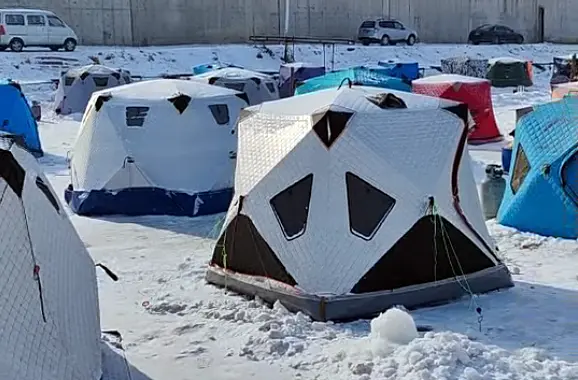
Inside the camp, they might add things like:
- A small insulated floor or mat
- A heater (often propane-based)
- A simple chair or bucket
- An underwater fishing camera with a DVR
A usual ice fishing camp setup will look something like this.
The real benefits of a camp beyond comfort are heat retention, better focus, improved dexterity, better ice hole management, and extended sessions. It is a great way to save yourself from the cold and sit for longer hours. Most people use portable pop-up tents designed for ice fishing. They are quick to deploy and can be anchored to ice. So, if you are planning to do longer fishing sessions on a frozen lake, you can always go for a camp setup. However, it adds to the total amount of gears. However, if you can afford it, you should definitely go for it.
How to Choose the Right Spot (Where Most People Fail)
Reading a Frozen Lake
Nothing is random underneath the ice. Fish generally position themselves around structures because it gives them protection and access to food. Structures create a natural gathering point. It also concentrates baitfish and provides reference points in an otherwise open environment.
Drop-offs are very important to check. These are the transition zones where shallow water meets deeper water, and fish use them as feeding lanes. Predators also sit just below the drop waiting for prey.
Weed beds provide shelter and oxygen and attract smaller fish. Smaller fish in turn attract larger ones. Underwater humps and ridges are also worth checking. These are elevated areas surrounded by deeper water. These are the areas where fish gather. A frozen lake hides all visual cues. What looks like an empty surface is literally a mapped environment under the thick ice sheet. So, instead of asking where I should drill, you should ask where the fish naturally want to be.
Always try to start near the shoreline but not right at the edge. Move about 10 to 20 meters inward before drilling your initial test hole.
Depth Strategy
Depth is one of the most misunderstood parameters in ice fishing. Beginners generally pick a depth randomly. Others just copy others without understanding why the fish are there. Fish position themselves on two main factors, i.e., oxygen levels and food availability.
- In early winters, oxygen is higher throughout the water. Fish are most active in this period and often stay in shallower areas.
- In mid-winter, oxygen levels drop in shallow water. Fish move deeper where conditions are more stable. Also, the activity reduces due to colder water.
- In the late season, oxygen levels improve near the surface, so fish start moving back toward the transitional zones.
Try to drill holes at different depths in this order:
- Hole 1: 1.5–2 meters (shallow)
- Hole 2: 3–4 meters (mid-range)
- Hole 3: 5–8 meters (deeper zone)
Then adjust based on results. If there is no bite in shallow after 15 to 20 minutes, it’s time to move deeper.
Drilling Strategy
Most beginners drill one hole, sit down, and wait. This approach mostly fails because you think fish will come to you. Experienced anglers do the opposite. They go to the fish.
Each hole you drill gives you information if you are able to catch it. It tells you the depth, information about the structure, and the fish activity or lack of it. Each hole is like an experiment for you.
Option 1: Straight Line (from shore outward)
- Drill 1st hole at around 10 to 15 meters from the shore
- Move forward and drill every 5 to 8 meters
- Stop after 5 to 7 holes
Option 2: Grid Pattern
- Drill holes in a zig-zag or square pattern
- Keep spacing around 5 to 7 meters
- Cover a wider area instead of just one direction
After drilling multiple holes, wait for 3 to 5 minutes before fishing. This allows fish to settle after disturbance.
Step-by-Step Workflow for Ice Fishing
For all the beginners, it is good to give a step-by-step guide to get started. Now because they don’t know what to do, this guide should help them do things in order and quickly with a proper plan.
Arrival Phase
We have a quick instinct to start drilling immediately. You’ll have to resist that first. Spend 3 to 5 minutes scanning the areas before touching your gear. Look for other anglers if they are clustered or spread out. If they are clustered, it is likely a productive zone, and you should try the location as well.
Avoid heavily trafficked spots. They are overfished and noisy. Check if the ice is clear or snow-covered. Wet patches or slush mean a potential weak spot. Position yourself 10 to 30 meters away from the obvious entry points.
Setup Phase
The first step is to drill your first hole at your chosen starting point. Immediately check the depth and observe the ice quality. This becomes your reference point. If you want to expand, expand with purpose. For beginners, this strategy works the best:
- Drill additional holes every 5 to 8 meters moving outward
- Drill 5 to 7 holes initially
- Try to drill holes in tight clusters (around 3 to 5 meters apart)
Use a skimmer immediately after drilling and prepare each hole before anything else. Make sure there is no slush, and you can see a clean water surface. This improves visibility, lure movement, and bite detection.
Fishing Phase
In the first drop, the moment your lure enters the water, you are not trying to catch a fish. You just understand the environment. Try to lower the bait slowly until it hits bottom. Reel up slightly and hold still for 5 to 10 seconds. Bottom zones often hold feeding fish, so starting slightly above the bottom avoids debris.
Do a quick test sequence in the first 2 to 3 minutes. Do a small jig movement of around 1 to 2 cm lifts. Pause for 3 to 5 seconds and repeat. If nothing happens, raise the bait 30 to 50 cm higher.
Obviously, this observation time can be shortened with a good underwater fishing camera. You will find out your own jigging strategy later on. But, for a beginner, controller movements and no random motion are advised. You can also add variations of movement if you get no response.
Conclusion
Ice fishing can be challenging if you do it just like normal open water fishing. It requires patience, special techniques, and sometimes special gear. However, this guide was supposed to get started with it, and we hope it will help you with the same. Try to avoid common ice fishing mistakes like moving bait too aggressively, not pausing long enough, and staying too long in dead holes. It is all about responsive patience. Blind waiting will lead to frustration, while constant adjustment will lead to patterns that help you become better over time.