
For centuries, fishing has relied on a mixture of instinct, experience, and a bit of luck. Anglers study water conditions, weather patterns, and underwater structures with the hope of placing their bait where fish are most likely to be. The real challenge is locating fish and understanding what they are doing beneath the surface. Anglers standing on the shore or in a boat can only see the water surface, while fish interact with vegetation, baitfish, and underwater structures. So, there is a lot of guesswork, which can significantly reduce your output.
Fishing cameras reduce this guesswork by allowing anglers to see what is going on underwater. These cameras can help us understand fish behaviour, vegetation, and bait reaction in real time. This allows anglers to make better decisions rather than relying entirely on trial and error. Underwater fishing cameras can be used for fish monitoring or in fisheries research because they provide direct visual observations of fish abundance and behavior.
Fishing cameras are a great tool that you should definitely invest in if you are serious about your fishing output and learning. Direct visual information can become the most important piece of the puzzle in your fishing journey. There are several other ways in which these cameras help anglers. But in this article, we will look at them mainly from the yield and experience perspective. We will know why finding fish is sometimes difficult and why anglers spend hours in unproductive water. Then, we will see how visual information from a fishing camera can help decision-making.
What Is an Underwater Fishing Camera?
An underwater fishing camera’s main component is a camera unit inside a waterproof housing connected to a DVR or a smartphone display. It will also have LED lighting for navigation and visual input in the darkness. Some will give you the option for infrared lighting in case there is near-zero visibility in the water. There will be a battery system and wiring that connects the camera to the unit that stays in your hand. Basically, an underwater fishing camera serves as an angler’s eye underwater.
They are similar to the normal underwater cameras but with designs made just for fishing. Modern underwater fishing cameras can have more features and extra things, but if it can show you what is going on underwater, it is generally enough. For some people, the recording function can be essential. More than this are generally the luxury features. If you want to know more about how to choose the right fishing camera, we have already posted a detailed guide.
Why Is Finding Fish Harder Than Most People Think?
There are four key reasons finding fish is harder than most of us assume. Let’s talk about these one by one.
Fish are constantly moving
Fish rarely stay in the same spot for long periods, firstly because of their nature. Also, they are searching for food all the time or avoiding predators. There are also seasonal migrations. A productive fishing spot in spring may hold very few fish during the heat of summer or the cold months of winter.
Water is three-dimensional
Unlike animals on the land, fish also have the advantage of moving in a three-dimensional space. They can occupy the surface of the water, choose to stay in the middle, or go really deep in the water. So, the anglers can end up casting repeatedly in one section of water while fish are holding a few feet above and below the lure. It is very possible that fish are just below your boat, and you have cast really deep in the water hoping to catch them.
Underwater Structures Hide Fish
The underwater environment and the inside structures, such as rock piles, weed beds, fallen trees, artificial reefs, or things like dock pilings, are great for the fish to hide. These structures protect fish from predators and offer ideal ambush points for hunting prey. From the surface, these structures are generally invisible, but they are always there, and you never know the fish is actually hiding while you lose hope thinking there is no fish at all.
Environmental Factors
Environmental factors make fish behavior even more unpredictable. Oxygen levels, water temperature, sunlight penetration, current strength, etc influence the location fish choose to spend their time. Even a small change can easily cause the fish to relocate. So, if a place was productive one time doesn’t mean it will stay productive. Without a way to see below the surface, you are left with the guesswork about where they have gone and why.
How Do Fishing Cameras Help You Find Fish?
As you lower your fishing camera into the water and turn on the video output, you get the visual feed from below the water. If the water is clear, you should be able to observe the underwater environment and see how fish react to your bait. But that isn’t all. Let’s see each benefit in detail.
1.They confirm whether fish are actually present
This is arguably the biggest benefit of a fishing camera. Most anglers waste their time and efforts simply because they don’t know if fish are even in the area. Basically, the guesswork is eliminated from the scene. Instead of wondering whether there are fish, you can see them directly. Without a camera, you can fish for 2 hours without any bites and be unsure why that happened. However, with a fishing camera, you can see if the fish are absent and move immediately from the location.
Beginners often struggle to differentiate poor technique from poor location. A good fishing camera helps answer this question. You don’t have to be a master in electronics or videography to use them. They are very easy-to-use and have one-time investment. So, if you want to save your precious time rather than relying completely on guesswork, a fishing camera is going to help.
2.They reveal fish behavior in real time
Finding fish doesn’t automatically mean catching them. It is very important to understand their behavior. Depending on various circumstances, fish can be feeding aggressively, curious, inactive, or stressed. So, your ability to catch them will vary heavily based on these things. In many cases, a fish will follow but not strike and then leave eventually. This tells anglers that there is either something wrong with the presentation or the retrieval speed, or, in some cases, the bait size.
Fishing cameras also reveal feeding activity, group movement, and competition among fish. Fish often react to shadows, boat movement, and sudden lure movement. So, with the visual information of all these things, you get to learn new behaviors and patterns underwater. This helps you improve your technique and make fewer mistakes.
3.They help identify productive underwater structure
As we discussed above, some areas or water bodies can become unproductive for several reasons, but mainly due to fish migration. However, fish rarely scatter randomly when they are present in a water body. Most species gather around objects that provide shelter, food, or protection. The key structures to look out for are weed beds, fallen trees, rock piles, docks, and piers.
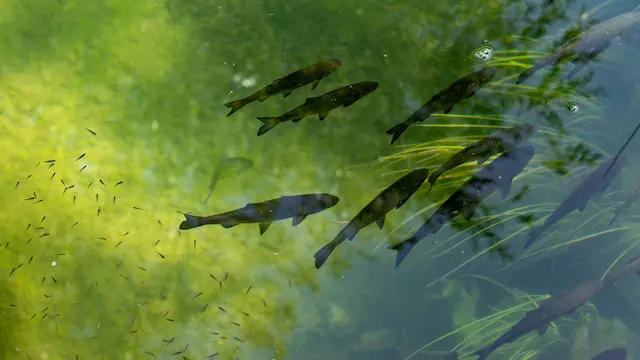
For example, fish use weed beds mainly for insects and oxygen. The fallen trees can be great for shade and cover. Rock piles are best for crayfish habitat or small fish populations. So, with a camera, you can observe all these things and see not only their existence but also their actual condition.
4.They help determine the right fishing depth
Many anglers fish at the wrong depth, and this impacts the yield more than anything. Fish change the depth first based on the seasons. In the summer, fish may move deeper in the water. However, in the spring, they will move to the shallower water. There are also temperature layers, and fish are sensitive to thermoclines and oxygen concentration, which keeps changing and hence affects the fish’s location.
There are suspended species that neither stay are surface or the bottom. Camera helps reveal this. So, the biggest benefit of a camera is that the angle can place the bait where fish actually are. You don’t have to learn the behavior changes based on the seasons. Your cameras will reveal everything, and you can actually see it with your eyes.
5.They Help You Select Better Baits and Lures
Most lure selection is educated guessing in most cases. For example, fish may ignore color but be inclined towards another one. A fishing camera helps with knowing this color preference. It also helps you know the retrieval speed. You can observe reactions to fast retrieves, slow retrieves, or stop-and-go presentations.
Fish also show preferences for small offerings or large prey. In some cases, fish are highly interested in your bait but refuse to strike. This information can be really valuable to know when changing your lures and baits. Without a camera, you never know what the response is, and hence you end up losing hope really soon.
6.They help you understand fish habitat
Different underwater plants attract different prey species. You can see different bottom compositions like mud, sand, gravel, or rocks. They heavily impact fish behavior and their preferences. Fish do not randomly choose locations within a lake or river. They are drawn to habitats that provide food, shelter, protection, and good living conditions. Aquatic vegetation is one of the most important habitat features that you should observe through an underwater fishing camera. Over time, studying underwater habitats can change the way anglers approach fishing. So, rather than searching for fish blindly, they can learn to identify the features that naturally attract them.
7.Underwater Fishing cameras during ice fishing
Ice fishing is much more challenging compared to normal fishing due to the limited visibility and changing fish location. However, a fishing camera allows you to watch fish approach baits, understand fish mood, and reduce unproductive waiting. You can adjust your jigging technique based on these inputs. We have already published a detailed guide on ice fishing, which you can definitely check out.

Fishing Cameras vs Fish Finders
A fish finder is great for quickly covering a large area and locating depth changes. They can also be great for finding schools. A fish finder uses sonar waves to map underwater structure, but they can’t show you the specific fish species and how they are reacting to your bait. Sonar emits ultrasonic sound waves into water and then listens back to the echoes that bounce off fish, vegetation, structures, and the lake bottom. The processor inside these devices analyzes the returning signals and converts them to a visual display showing depth, fish locations, and underwater structures.
Modern wireless fish finders are capable of transmitting this information directly to smartphones, allowing anglers to view underwater in real time.
Fish finders are best suited for:
- Locating fish over large areas of water
- Measuring water depth accurately
- Mapping bottom contours and underwater terrain
- Finding drop-offs, ledges, channels, and humps
- Working in muddy or low-visibility water
- Providing continuous depth and temperature information
Sonar doesn’t depend on visual inputs, so water clarity doesn’t matter. Fish finders are also great for scouting large areas, locating drop-offs, and identifying submerged structures.
What underwater fishing cameras do best?
While fish finders are great for locating potential targets, they can’t tell what the angler is actually seeing. A sonar may help you indicate a fish or vegetation but manual interpretation is often required. The fishing cameras have significant advantages here.
A fishing camera gives you the visual output that you can see in real time on a screen. They are great for confirming the fish and seeing underwater structures. They help you see the fish’s reaction to your bait and enhance your skills over time. However, these cameras depend heavily on water clarity; otherwise, you have to use IR light, which doesn’t provide color information but lets you see in murky water.
A Fishing camera is best suited for:
- Identifying fish species
- Approximate fish size
- Checking fish reaction to specific lures or baits
- Checking bottom composition such as sand, mud, gravel, or rock
- Baitfish activity
- The condition of underwater structures.
The Biggest difference is between detection and observation
Both these technologies have their own pros and cons, and you can choose one based on your specific needs. In fact, we should not compare these two because both serve different purposes using different techniques.
The simplest way to understand this difference is that fish finders are designed primarily for detection of fish while underwater fishing cameras are designed for observation. A fish finder will answer questions such as how deep the water is and what the structure below is. It can help you confirm whether there are fish in the water and the depth they are holding. However, a fishing camera will help you identify specific species and how they are behaving underwater. You can see whether they are actively feeding and what habitat they are using. So, you get more visual information of everything that is going on below the water surface.
Pros and Cons of Fishing Cameras for Fishing
For beginners, there are hardly any cons but all the benefits. But because they depend on the lighting to capture the video, the underwater environment can heavily impact what you can actually see. Let’s see some of the pros and cons.
| Pros | Cons |
| Visual confirmation of fish presence | Performance depends on water clarity |
| Better understanding of fish behavior | Limited field of view in some models |
| Helps identify productive structures | Less effective in covering large areas compared to sonar |
| Improves bait and lure selection | |
| Helps find the right fishing depth | |
| Excellent learning tool for both beginners and experts |
Conclusion
Underwater fishing cameras are most effective in clear lakes, reservoirs, ice fishing, dock fishing, crappie fishing, panfish fishing, and structure fishing. You can experiment on your own in different areas and water bodies. As long as you get the visual input from underwater, it is always going to help you in some way. You will learn more about a specific lake and can start to find new patterns. However, if you keep changing your location, you will save your time and effort without depending on any guesswork. This is going to be a one-time investment, but if you are serious about learning and improving your fishing output, it is always a worthy spend.